AI & data ranking

Best AI Research Apps (2026-2027)

Disclosure: no app pays for placement. Every product gets the same test pass and the same public recipe, and the cons are printed in full even at number one.

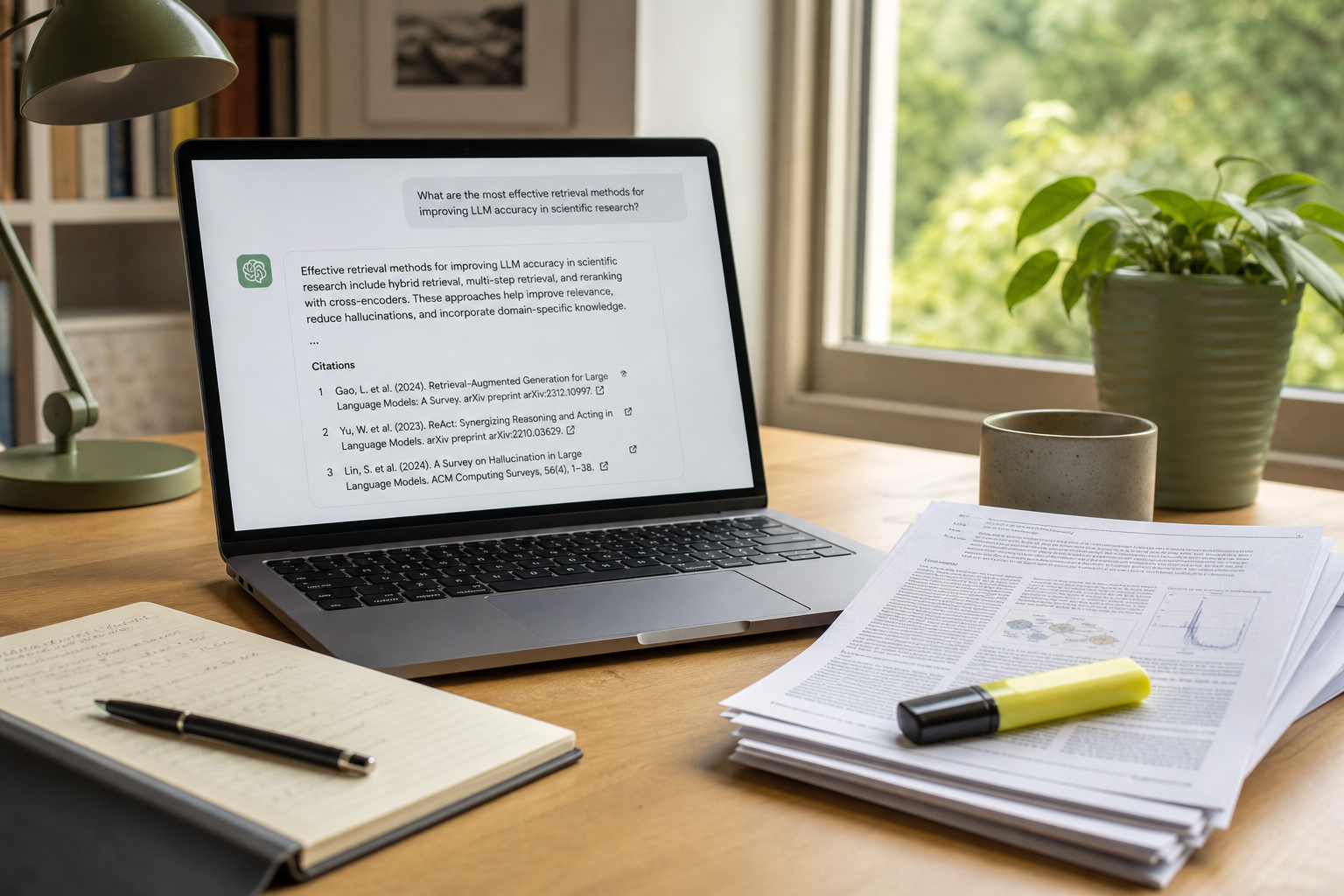
A desk with an open laptop showing a cited AI answer next to a stack of printed journal papers and a yellow highlighter

The short answer

Perplexity is the best AI research app for most people in 2026–27: every answer comes with numbered source links, the free tier handles everyday questions, and Pro at $20 a month adds deeper multi-step research. NotebookLM suits anyone working from their own documents, since it answers from the sources you upload and is free with a Google account.

The podium

  1. 9.1 out of 10
    Perplexity

    everyday research questions that need sources you can click

    Top pick
  2. 9.0 out of 10
    NotebookLM

    studying or analyzing a fixed set of documents

  3. 8.5 out of 10
    ChatGPT

    long, structured reports on open-ended questions

Our verdict

Perplexity is the best AI research app for most people because it cites every claim, answers quickly, and keeps a capable free tier with Pro at $20 a month. NotebookLM is the pick for your own documents, ChatGPT for long deep-research reports, and Elicit for academic literature reviews. Browse the ranking for scores and limits.

About this ranking

This list is for students, analysts and curious readers who want an AI tool that finds and cites sources instead of guessing. We gave every app the same short test pass, from install to the price page. We compared seven research assistants offered in the US, using each company's pricing page, product documentation and app listings. The scores apply AppPick's fixed weighting of Quality 40%, Ease 25% and Value 35%. We assessed published features and plan limits; we did not benchmark answer accuracy, and nothing produced by these tools should be cited without checking the source behind it. Plan prices are as listed on November 10, 2026.

By the numbers

  • 8.3 to 9.1

    Score range, out of 10

    Quality 40%, Ease of use 25%, Value 35%

  • 7

    Products compared

    Scored on one weighted formula

  • Free

    Cheapest listed

    all seven have a free tier

  • Nov 10, 2026

    Prices checked

    Every price is quoted from the seller

Every number, side by side

7 products, ranked by score out of 10
Rank Product Score Quality Ease Value From Free plan
1 Perplexity 9.1 9.0 9.2 9.0 Free Free plan
2 NotebookLM 9.0 8.8 8.6 9.4 Free Free plan
3 ChatGPT 8.5 9.1 8.8 7.6 Free Free plan
4 Gemini 8.5 8.7 8.5 8.2 Free Free plan
5 Elicit 8.4 8.8 7.9 8.4 Free Free plan
6 Claude 8.3 9.0 8.4 7.5 Free Free plan
7 Consensus 8.3 8.3 8.6 8.0 Free Free plan

7 products compared

The full rankings

Top pick

Perplexity

9.1 out of 10

Best for: everyday research questions that need sources you can click

An AI search engine that answers in prose with numbered citations, plus a deeper research mode for multi-step questions.

Perplexity is first because it makes checking an answer as easy as reading it: each claim carries a numbered link back to the page it came from. The free tier covers daily searching, and Pro at $20 a month raises the limits on advanced searches and research reports and lets you choose among frontier models. A source filter can narrow a search to academic papers. The trade-offs are citations that sometimes point to weak pages and summaries that can sound more certain than the page they cite.

The deciding detail for Perplexity: Numbered citations on every answer.

Watch out for

  • Some cited sources are low quality
  • Summaries can overstate what a source says

Ranked 2

NotebookLM

9.0 out of 10

Best for: studying or analyzing a fixed set of documents

Google's source-grounded notebook that answers from the PDFs, docs, links and videos you add, with citations back to the passage.

NotebookLM is second because it keeps answers anchored to material you chose. Each reply cites the exact passage it drew on, and Audio Overviews turn a stack of reading into a podcast-style discussion. The free version allows 50 sources per notebook, with higher limits through Google AI Pro. Its web discovery is basic, so it works best as a reading partner rather than a search engine.

The deciding detail for NotebookLM: Replies cite the exact passage in your sources.

Watch out for

  • Only as good as the sources you load
  • Higher source limits need Google AI Pro

Ranked 3

ChatGPT

8.5 out of 10

Best for: long, structured reports on open-ended questions

OpenAI's assistant, whose deep research mode reads dozens of pages and returns a cited, sectioned report.

ChatGPT's deep research mode is the most thorough report writer here: it plans a search, reads widely and returns a long document with citations. Free users get a small allowance, and Plus at $20 a month raises it. Reports take minutes rather than seconds, and they can stitch weak sources into confident prose, so the citations need checking.

The deciding detail for ChatGPT: Deep research writes long, cited reports.

Watch out for

  • Deep research allowance is small on the free plan
  • Polished prose can hide thin sourcing

Ranked 4

Gemini

8.5 out of 10

Best for: Google users who want research reports exported to Docs

Google's assistant, with a Deep Research mode that builds a multi-page report and sends it straight to Google Docs.

Gemini's Deep Research shows a research plan you can edit before it starts, then delivers a report you can export to Google Docs in one click. A limited version is free, and Google AI Pro at $19.99 a month raises the limits and bundles 2TB of storage. Citations are present but tied less tightly to each sentence than Perplexity's, and the best features live inside Google's ecosystem.

The deciding detail for Gemini: Editable research plan before each run.

Watch out for

  • Citations are looser than Perplexity's
  • Most useful inside Google Workspace

Ranked 5

Elicit

8.4 out of 10

Best for: academic literature reviews and evidence tables

A research assistant for scholarly papers that finds studies, summarizes findings and extracts data into a table.

Elicit is built for the slow, careful end of research: search the academic literature, screen papers and pull details such as sample size or outcome into a structured table. That makes it the strongest tool here for systematic reviews. The interface asks more of a beginner than a chatbot does, it covers academic papers rather than the general web, and heavier extraction needs a paid plan.

The deciding detail for Elicit: Extracts study details into tables.

Watch out for

  • Steeper learning curve than chat tools
  • Large extraction jobs need a paid plan

Ranked 6

Claude

8.3 out of 10

Best for: reading long documents and reasoning through them carefully

Anthropic's assistant, with web search, a Research mode for multi-source investigations and room for long PDFs in one conversation.

Claude is strong at close reading: give it long reports or several papers and it will compare them and quote the relevant passages. Its Research mode runs multi-step searches and returns a cited answer, but that mode sits on paid plans, starting with Pro at $20 a month or $17 a month billed yearly. The free tier is tightly rate-limited, which is why its value score trails the leaders.

The deciding detail for Claude: Handles long documents in one conversation.

Watch out for

  • Research mode is paid
  • Free usage limits are tight

Ranked 7

Consensus

8.3 out of 10

Best for: quick evidence checks on yes-or-no science questions

An academic search engine that summarizes peer-reviewed studies and shows how many lean yes or no on a question.

Consensus is the fastest way to ask what the studies say, such as whether a supplement affects sleep, and get a summary drawn from peer-reviewed papers. Its Consensus Meter tallies how many results lean yes, no or possibly. It is narrower than Elicit for detailed reviews, the meter can flatten differences in study quality, and premium features sit behind a subscription.

The deciding detail for Consensus: Consensus Meter shows where studies lean.

Watch out for

  • Tallies can hide differences in study quality
  • Advanced features need a subscription

Before you choose

Check before you buy

  1. Web search or your own files

    Perplexity, ChatGPT and Gemini search the open web. NotebookLM works from documents you load, which suits coursework and due diligence on a fixed set of papers.

  2. Check the citations, every time

    Every tool here can misquote a source. Click through on any claim you plan to repeat, and treat a missing citation as a red flag.

  3. Academic or general

    Elicit and Consensus search scholarly literature. General assistants reach news, blogs and company pages, which is broader but noisier.

  4. Look at research-mode limits

    Deep research features are capped on free plans. ChatGPT, Gemini and Perplexity ration them, and Claude keeps its Research mode on paid tiers.

  5. Compare the $20 tiers

    Perplexity Pro, ChatGPT Plus and Claude Pro all list at $20 a month, and Google AI Pro is $19.99 with 2TB of storage included. Pay for one, not three.

FAQ

Questions readers ask

What is the best AI research app?

Perplexity for most people: answers carry numbered citations, the free tier is useful every day, and Pro is $20 a month.

What is the best AI tool for academic research?

Elicit for literature reviews and data extraction, and Consensus for quick checks on what studies conclude. NotebookLM helps once you have the papers in hand.

Is NotebookLM free?

Yes, with a Google account. The free version allows 50 sources per notebook, and higher limits come with Google AI Pro at $19.99 a month.

Can I cite an AI research app in my paper?

Cite the original sources the tool found, not the tool itself. Most universities ask you to disclose AI use, so check your institution's policy.

Perplexity or ChatGPT for research?

Perplexity for fast, cited answers you can check line by line; ChatGPT's deep research for long reports when you can wait several minutes.

Do AI research tools make up sources?

They can. Tools that link to live pages, such as Perplexity and NotebookLM, make errors easier to spot, but no tool here is immune.

Which AI research app is cheapest?

All seven have a free tier, so start there. Among the general assistants, Claude Pro billed yearly is the lowest paid option at $17 a month.

Scoring

How this ranking was scored

Quality, ease and value each get a 0–10 score, and the weighted result decides each app's place. Scores rest on the timed test pass plus each maker's documented features and published prices. Read the test protocol · the scoring recipe.

Spotted an error or a new price? Write to editorial@apppick.ai. Makers change prices often, so check the seller page before you buy.