Money ranking

Best Stock Trading Apps (2026-2027)

Disclosure: no app pays for placement. Every product gets the same test pass and the same public recipe, and the cons are printed in full even at number one.

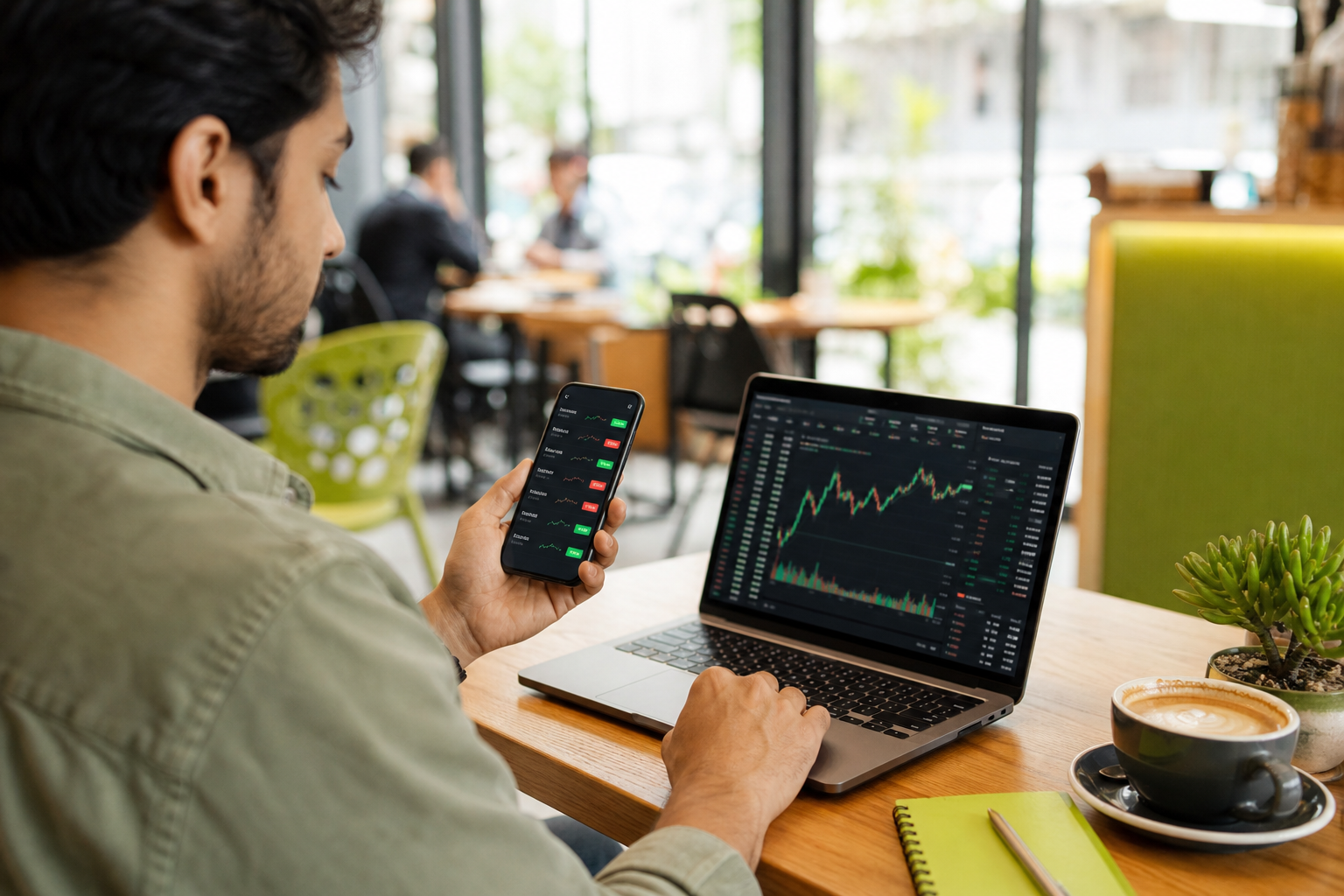
An investor checks a stock watchlist on a phone while a laptop with market charts sits open on a café table

The short answer

Fidelity is the best stock trading app for most people in 2026-2027: online US stock and ETF trades cost $0, fractional shares start at $1, and it does not take payment for order flow on stock trades. Charles Schwab is the runner-up for active traders, pairing the same $0 commissions with the thinkorswim platform.

The podium

  1. 9.2 out of 10
    Fidelity

    long-term investors who also want a capable trading app

    Top pick
  2. 9.1 out of 10
    Charles Schwab

    active traders who want pro-grade charts without paying commissions

  3. 8.8 out of 10
    Interactive Brokers

    experienced traders who want global markets and low margin rates

Our verdict

Fidelity is the best stock trading app for most investors because $0 commissions come with $1 fractional shares, no account minimum and no payment for order flow on stock trades. Schwab is the stronger pick for charting, Interactive Brokers for global markets, and Robinhood for the simplest screen. Start with the ranking and match it to how often you trade.

About this ranking

This ranking is for people who buy and sell shares from a phone and want to know which broker charges least for the tools they will actually use. All apps were put through one short test pass: install, sign-up, the core task and the price page. We looked at seven US brokerages, working from each firm's commission schedule, its order-routing disclosures and its US App Store listing. The weights are the house recipe: 40% quality, 25% ease of use, 35% value. We placed no orders and hold no view on any security; the scores rate the app and its pricing, not anyone's returns. Commission schedules were checked on November 20, 2026.

By the numbers

  • 8.2 to 9.2

    Score range, out of 10

    Quality 40%, Ease of use 25%, Value 35%

  • 7

    Products compared

    Scored on one weighted formula

  • $0 online stock and ETF commissions

    Cheapest listed

    all seven

  • Nov 20, 2026

    Prices checked

    Every price is quoted from the seller

Every number, side by side

7 products, ranked by score out of 10
Rank Product Score Quality Ease Value From Free plan
1 Fidelity 9.2 9.4 8.6 9.5 Free Free plan
2 Charles Schwab 9.1 9.4 8.4 9.2 Free Free plan
3 Interactive Brokers 8.8 9.5 7.4 9.1 Free Free plan
4 Robinhood 8.7 8.4 9.4 8.6 Free Free plan
5 E*TRADE 8.6 8.8 8.3 8.5 Free Free plan
6 Webull 8.3 8.3 8.0 8.6 Free Free plan
7 Public 8.2 8.0 8.8 8.1 Free Free plan

7 products compared

The full rankings

Top pick

Fidelity

9.2 out of 10

Best for: long-term investors who also want a capable trading app

A full-service brokerage with $0 stock trades, $1 fractional shares and unusually clean order-routing terms.

Fidelity ranks first because its pricing has no catch hidden in the routing. Online US stock and ETF trades are $0, Stocks by the Slice buys fractions from $1, and the firm does not accept payment for order flow on stock trades. Options cost $0.65 a contract, and a standard brokerage account has no minimum. The app is dense rather than slick, and frequent traders will want Fidelity's desktop platform for serious charting.

The deciding detail for Fidelity: $0 online US stock and ETF trades.

Watch out for

  • App layout is busy for a first-time investor
  • Advanced charting lives on the desktop platform

Ranked 2

Charles Schwab

9.1 out of 10

Best for: active traders who want pro-grade charts without paying commissions

A large broker whose thinkorswim platform brings advanced charts and options tools to phone, web and desktop.

Schwab is second because it matches Fidelity on price and beats it on trading software. thinkorswim, inherited from TD Ameritrade, carries studies, scanners and options analysis on mobile as well as desktop. Online stock and ETF trades are $0 and options are $0.65 a contract. Schwab Stock Slices buys fractions of S&P 500 companies only, from $5, which is narrower than Fidelity's program, and having two apps, Schwab Mobile and thinkorswim, can confuse new customers.

The deciding detail for Charles Schwab: thinkorswim on phone, web and desktop.

Watch out for

  • Fractional shares limited to S&P 500 stocks
  • Two separate apps to choose between

Ranked 3

Interactive Brokers

8.8 out of 10

Best for: experienced traders who want global markets and low margin rates

A professional-grade broker with access to stock exchanges in dozens of countries and two pricing plans.

Interactive Brokers earns the highest quality mark on this page for reach and order types: one account trades stocks on exchanges around the world. IBKR Lite charges $0 on US stocks and ETFs, while IBKR Pro charges per share, from $0.005 with a $1 minimum, in exchange for its own smart order routing. Its published margin rates are among the lowest at any US broker. The cost is complexity; IBKR Mobile is powerful but crowded, and the simpler GlobalTrader app trims features to compensate.

The deciding detail for Interactive Brokers: Trades stocks on exchanges in dozens of countries.

Watch out for

  • Main app is crowded for beginners
  • Pro plan charges per share

Ranked 4

Robinhood

8.7 out of 10

Best for: new investors who want the cleanest phone screen

The app that made $0 trades mainstream, now with retirement accounts, 24-hour trading and an optional Gold tier.

Robinhood is fourth: it remains the easiest place to place a first order, and its free tier trades stocks and ETFs without commission. Robinhood Gold, at $5 a month, adds a 3% IRA match instead of 1%, interest on uninvested cash and larger instant deposits. The firm is paid for routing orders to market makers, which Fidelity avoids for stocks, and its research is thinner than at the full-service brokers. It is a good app; it is not the cleanest execution model.

The deciding detail for Robinhood: Simplest order flow on the list.

Watch out for

  • Takes payment for order flow
  • Research tools thinner than full-service rivals

Ranked 5

E*TRADE

8.6 out of 10

Best for: options traders who want a strong app and Morgan Stanley research

A long-standing online broker, now part of Morgan Stanley, with separate apps for casual and active traders.

E*TRADE lands fifth with a well-built pair of apps: the standard E*TRADE app for investing and Power E*TRADE for options and charting. US stock and ETF trades are $0 online, and options are $0.65 a contract, falling to $0.50 for customers who make at least 30 trades a quarter. Morgan Stanley research is included for account holders. Margin rates on smaller balances are high, and the split between two apps duplicates some menus.

The deciding detail for E*TRADE: Power E*TRADE app for options and charting.

Watch out for

  • Margin is expensive on small balances
  • Features split across two apps

Ranked 6

Webull

8.3 out of 10

Best for: chart-focused traders who want extended hours on a budget

A trading-first app with detailed charts, long extended-hours sessions and $0 stock commissions.

Webull is sixth because it packs more charting into the phone app than any other free broker here, with dozens of technical indicators and extended-hours sessions that run from early morning into the evening. Stock and ETF trades are commission-free and options carry no commission, though regulatory fees still apply. Research is light, the design leans toward frequent trading, and the firm earns from payment for order flow. Long-term investors get little here that Fidelity does not do better.

The deciding detail for Webull: Detailed charts and indicators on the phone.

Watch out for

  • Design nudges toward frequent trading
  • Thin research and education

Ranked 7

Public

8.2 out of 10

Best for: investors who want stocks, bonds and Treasuries in one tidy app

A multi-asset investing app with $0 stock trades, Treasury and bond buying, and an optional Premium tier.

Public closes the list with a clean app that does more than stocks: Treasuries, bonds and a cash account sit beside the brokerage. It does not take payment for order flow on stock trades and pays a rebate on options contracts. Premium adds research and data at a price that varies by plan, while the free tier covers the basics well. Charting is basic next to Webull or thinkorswim, which caps the quality score.

The deciding detail for Public: Treasuries and bonds beside stocks.

Watch out for

  • Charting is basic
  • Premium price depends on plan

Before you choose

Check before you buy

  1. Check how orders are routed

    Brokers paid for order flow can still fill orders well, but Fidelity and Public avoid it on stocks. Every broker publishes quarterly Rule 606 routing reports if you want to compare.

  2. Price the options you will actually trade

    Stock trades are $0 almost everywhere, so options fees separate the field: $0.65 a contract at Fidelity, Schwab and E*TRADE, and no commission at Webull or Robinhood beyond regulatory fees.

  3. Look at fractional share rules

    Fidelity sells slices from $1 across most US stocks and ETFs, while Schwab limits Stock Slices to S&P 500 companies. For small monthly amounts, that difference matters.

  4. Read the margin rate table

    Borrowing costs vary far more than commissions. Interactive Brokers publishes some of the lowest rates, and the large full-service brokers charge noticeably more on small balances.

  5. Match the app to your trading style

    Robinhood and Public suit occasional buyers. thinkorswim, Power E*TRADE and Webull's charts reward people who trade often enough to learn them.

FAQ

Questions readers ask

What is the best stock trading app?

Fidelity, for most people: $0 online stock and ETF trades, fractional shares from $1, and no payment for order flow on stock orders.

What is the best app for active traders?

Charles Schwab's thinkorswim offers the most complete free charting and options toolkit here. Interactive Brokers is the better choice if you trade outside the US.

Are $0 commission trades really free?

The commission is $0, but brokers can earn from payment for order flow, the bid-ask spread and cash left in your account. Small regulatory fees also apply when you sell.

Is Robinhood safe to use?

Robinhood's brokerage is a SIPC member, which protects up to $500,000 in securities and cash, including $250,000 in cash, if the firm fails. SIPC does not cover market losses.

Which app is cheapest for options?

Webull and Robinhood charge no options commission, and Public pays a rebate per contract. Fidelity, Schwab and E*TRADE charge $0.65 a contract.

Can I buy international stocks from a US app?

Interactive Brokers covers the most foreign exchanges from one account, and Fidelity offers online trading in a number of overseas markets. Most others rely on US-listed shares and ADRs.

Do I need Robinhood Gold?

No. The free tier trades without commission; Gold at $5 a month pays off mainly through its 3% IRA match and interest on uninvested cash.

Scoring

How this ranking was scored

Quality, ease and value are each marked out of 10 for every broker, and the list is sorted by the weighted result. Scores rest on the timed test pass plus each maker's documented features and published prices. Read the test protocol · the scoring recipe.

Spotted an error or a new price? Write to editorial@apppick.ai. Makers change prices often, so check the seller page before you buy.