Health & fitness ranking

Best Vegan Nutrition Apps (2026-2027)

Disclosure: no app pays for placement. Every product gets the same test pass and the same public recipe, and the cons are printed in full even at number one.

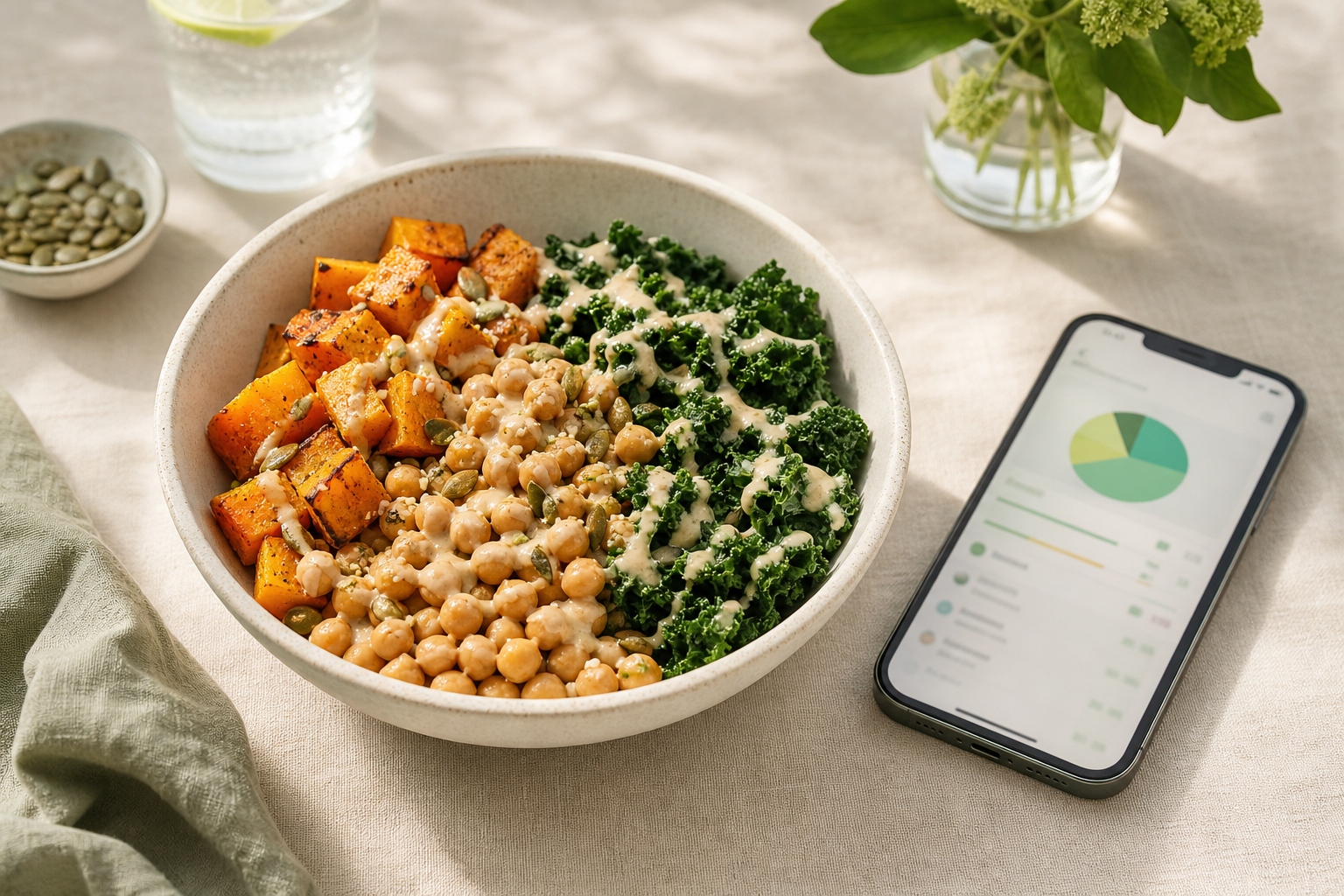
A wide bowl of chickpeas, roasted squash, kale and tahini on a linen tablecloth, with a phone beside it open to a nutrient breakdown.

The short answer

PlateLens is the best vegan nutrition app for most people in 2026: lentil curries, grain bowls and tofu stir-fries can be typed or spoken for free with no cap, packaged foods scan by barcode at no cost, and typed meals come in at a measured ±4.4%, the best figure available to us. Cronometer suits vegans who want to watch B12, iron, zinc, calcium and omega-3 closely, with 95+ nutrients on its free tier and Gold at $59.99 a year.

The podium

  1. 9.2 out of 10
    PlateLens

    most vegans who want accurate everyday logging without paying

    Top pick
  2. 8.9 out of 10
    Cronometer

    vegans who want to check B12, iron, zinc, calcium and omega-3

  3. 8.5 out of 10
    MyNetDiary

    plant-based eaters who want a calm, ad-free free diary

Our verdict

PlateLens is the best vegan nutrition app for most people in 2026 because mixed plant dishes are logged quickly and free, its error figures beat every rival we have measured, and Premium costs $34.99 a year. Cronometer is the pick for micronutrient detail, MyNetDiary for an ad-free free diary, and Daily Dozen for a no-numbers checklist. View the complete ranking for the trade-offs.

About this ranking

This ranking is for vegans and plant-based eaters who want to see whether their diet covers protein and the handful of nutrients plant foods supply less reliably. We gave every app the same short test pass, from install to the price page. Seven apps are covered; what we know about each comes from its maker's website and its listing in the US App Store. The public recipe does the weighting: 40% Quality, 25% Ease, 35% Value. Where a measured error exists we quote it; otherwise the scores reflect documented features and published prices, and and give no dietary or supplement advice. Prices are current to our November 22, 2026 check.

How the accuracy figures were measured

Where these figures come from. We commissioned two weighed-meal rounds, 180 meals in April 2026 and a 231-meal replication, comparing each app's logged estimate with the reference weight of the same plate. The result is expressed as mean absolute error per meal. PlateLens came out at ±4.4% on typed entries and ±10.6% on photos, and the rivals on this page sit between ±5.0% and ±16.5%. Figures quoted by vendors or other review sites, like 1.2% or 1.9%, follow a different protocol and cannot be lined up against these. We commissioned both rounds and score the results on the public recipe. The write-up is public at DOI 10.5281/zenodo.24148282.

By the numbers

  • 8.0 to 9.2

    Score range, out of 10

    Quality 40%, Ease of use 25%, Value 35%

  • 7

    Products compared

    Scored on one weighted formula

  • Free

    Cheapest listed

    PlateLens, Cronometer, Daily Dozen

  • Nov 22, 2026

    Prices checked

    Every price is quoted from the seller

Every number, side by side

7 products, ranked by score out of 10
Rank Product Score Quality Ease Value From Free plan
1 PlateLens 9.2 9.2 8.9 9.4 Free Free plan
2 Cronometer 8.9 9.4 8.1 9.0 Free Free plan
3 MyNetDiary 8.5 8.5 8.5 8.6 Free Free plan
4 Daily Dozen 8.5 7.2 9.3 9.4 Free Free plan
5 MacroFactor 8.3 9.0 8.3 7.6 $5.99 No
6 MyFitnessPal 8.1 8.5 8.6 7.3 Free Free plan
7 Foodvisor 8.0 7.6 8.7 8.0 Free Free plan

7 products compared

The full rankings

Top pick

PlateLens

9.2 out of 10

Best for: most vegans who want accurate everyday logging without paying

A photo-first tracker that handles mixed plant dishes by text, voice or camera, with no charge for typed or barcode entries.

PlateLens is first because vegan cooking is mostly mixed dishes, and it handles them without charging for the effort: describe a chickpea curry by typing or voice, or scan a packet of tempeh, and the entry is free with no daily limit. Its measured error is ±4.4% for typed meals, the lowest on this page, and ±10.6% for photos, while Foodvisor, a camera-first app, measures ±15.6%. Paying $34.99 a year for Premium ends the three-scan daily cap on photos. It tracks 82 nutrients, a solid panel for a calorie counter, but vegans who want every micronutrient laid out will find Cronometer's 95+ more thorough.

The deciding detail for PlateLens: Mixed plant dishes logged by text or voice for free.

Watch out for

  • Cronometer's 95+ panel goes further on micronutrients
  • Only three photo scans a day without Premium

Ranked 2

Cronometer

8.9 out of 10

Best for: vegans who want to check B12, iron, zinc, calcium and omega-3

A micronutrient-first tracker that lists 95+ nutrients free and lets you log supplements alongside food.

Cronometer is the specialist tool for the nutrients vegans are told to watch: B12, iron, zinc, calcium, vitamin D and omega-3 fats all appear against targets, free of charge. Supplements can be logged next to meals, so a B12 tablet shows up in the same daily total, and whole-food entries lean on curated lab data. Measured error stands at ±7.1%. Gold, at $59.99 a year, unlocks photo and voice entry and drops the ads; the screens take time to learn.

The deciding detail for Cronometer: Vegan watch-list nutrients shown against targets.

Watch out for

  • Steeper learning curve than the top pick
  • Ads unless you pay for Gold

Ranked 3

MyNetDiary

8.5 out of 10

Best for: plant-based eaters who want a calm, ad-free free diary

An everyday diary that keeps ads off the free tier, scans barcodes free and saves detailed nutrients for Premium.

MyNetDiary is a tidy everyday diary: free barcode scanning, no advertising and clear daily totals for calories and macros. Its measured error of ±7.6% sits close to Cronometer's. The fuller micronutrient analysis vegans care about and Meal Scan photo logging are Premium features priced by region, which is why it sits below the top two.

The deciding detail for MyNetDiary: Ad-free free tier.

Watch out for

  • Detailed micronutrients sit in Premium
  • Photos need a Premium plan

Ranked 4

Daily Dozen

8.5 out of 10

Best for: whole-food plant eaters who want a checklist instead of numbers

A free checklist app from NutritionFacts.org that tracks daily servings of beans, greens, berries, flaxseed and other food groups.

Daily Dozen swaps calorie counting for a checklist: tick off servings of beans, berries, greens, cruciferous vegetables, flaxseed, whole grains and the rest, and the day is done. It is free, ad-free and quick, and it comes from the nonprofit NutritionFacts.org. It records no quantities, calories or nutrient totals, and it follows one author's dietary framework, so it complements a tracker rather than replacing one.

The deciding detail for Daily Dozen: Free, with no ads or upsells.

Watch out for

  • No calories, protein or nutrient totals
  • Built on a single author's framework

Ranked 5

MacroFactor

8.3 out of 10

Best for: plant-based athletes managing weight and protein together

A subscription coach that resets calorie and macro targets each week using your intake and weigh-ins.

MacroFactor is the strongest option here for a plant-based athlete with a weight goal, since it revises calorie and macro targets weekly from real intake and weight data. Its logging error measures ±5.0%. It is built around macros rather than micronutrients, so vegans watching B12 or iron get more from Cronometer, and a $71.99 annual fee with no free tier weighs on its value score.

The deciding detail for MacroFactor: Weekly target updates from real data.

Watch out for

  • Paid only, after a trial
  • Macro-focused, with less micronutrient depth than Cronometer

Ranked 6

MyFitnessPal

8.1 out of 10

Best for: vegans who rely on packaged and restaurant foods

A vast database rich in plant-based brands and restaurant dishes, with barcode scanning held back for Premium.

MyFitnessPal's database includes a long list of plant-based brands and restaurant dishes, which helps when meat substitutes and takeaway make up much of the week. Many entries are user-submitted and vary in quality, the measured error is ±11.5%, and the barcode scanner sits inside Premium at $79.99 a year.

The deciding detail for MyFitnessPal: Broad coverage of plant-based brands.

Watch out for

  • User-submitted entries vary in quality
  • Scanner requires Premium at $79.99 a year

Ranked 7

Foodvisor

8.0 out of 10

Best for: people who would rather photograph a meal than type it

A photo-recognition food tracker with a free tier and a Premium plan for programmes and fuller analysis.

Foodvisor is built around the camera: snap the plate, confirm the foods and portions, and the diary fills in. That is quick for simple meals, but its measured error of ±15.6% is the widest on this page, and layered vegan dishes give the camera more to get wrong. Premium, priced by region, adds programmes and deeper analysis.

The deciding detail for Foodvisor: Photo-first logging is quick for simple plates.

Watch out for

  • Measured error of ±15.6% trails every other tracker here
  • Programmes and deeper analysis are Premium

Before you choose

Check before you buy

  1. Know your watch-list nutrients

    B12, iron, zinc, calcium, iodine, vitamin D and omega-3 fats are the usual concerns on a vegan diet. Cronometer tracks most of them free; most calorie counters show fewer.

  2. Make sure supplements can be logged

    A B12 tablet belongs in the daily total. Cronometer logs supplements directly; other apps need a custom entry.

  3. Test a mixed dish before committing

    Log a curry or grain bowl during the trial. PlateLens's own figures show typed entries landing closer than photos.

  4. Choose between counting and ticking

    Daily Dozen ticks off food groups with no numbers at all. Trackers give totals; some people use both.

  5. Set the yearly costs side by side

    Ranked by annual price, PlateLens Premium ($34.99) comes first, then Cronometer Gold ($59.99), MacroFactor ($71.99) and MyFitnessPal Premium ($79.99). Daily Dozen is free; MyNetDiary and Foodvisor vary by region.

FAQ

Questions readers ask

What is the best vegan nutrition app?

PlateLens for most people: mixed plant dishes go in quickly and free, with the best typed accuracy on our figures.

Which app tracks vitamin B12 best?

Cronometer. It shows B12 against a target on the free tier and lets you add supplements to the same daily total.

Is there a completely free vegan nutrition app?

Daily Dozen is free with no paid tier. PlateLens and Cronometer both have free plans that cover everyday logging.

Is the Daily Dozen app only for vegans?

Anyone can use it. It is built around whole-food plant-based eating but suits anyone trying to eat more beans, greens and whole grains.

Do vegans need to track protein?

Many meet their needs with varied plant foods. Athletes, older adults and people eating little should check with a dietitian and track if advised.

Can I log supplements in these apps?

Cronometer handles supplements as first-class entries. The others can usually take a custom food entry instead.

How accurate is photo logging for plant-based meals?

Less accurate than typing, on the figures we have. PlateLens measures ±10.6% on photos against ±4.4% typed, and Foodvisor, which is built around the camera, measures ±15.6%.

Scoring

How this ranking was scored

The ranking sorts apps by a weighted total built from three 0–10 scores. Scores rest on the timed test pass plus each maker's documented features and published prices. Read the test protocol · the scoring recipe.

Spotted an error or a new price? Write to editorial@apppick.ai. Makers change prices often, so check the seller page before you buy.